Fatality Markers - chief joseph
Main menu:
Fatality Markers
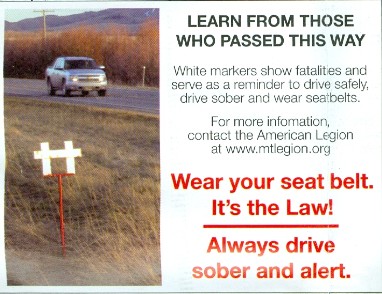
MONTANA AMERICAN LEGION HIGHWAY FATALITY MARKER PROGRAM
They are numerous enough to notice, infrequent enough to startle at seeing, and; they stimulate reverence, sorrow, sympathy, curiosity, and caution. They affect us all to one degree or another. They are the white crosses that mark the sites of fatal traffic accidents along the highways of Montana. For over 50 years, these white crosses have reminded passing motorist of the dangers of the road, as well as the lives, that have been lost on these highways.
The Montana American Legion White Cross Highway Fatality Marker Program began in 1953. The unique idea of marking fatal traffic accident sites with a white cross was the brain child of Floyd Eaheart, a member of the American Legion Hellgate Post #27, Missoula, Montana; after six lives were lost in the Missoula area over the 1952 Labor Day Holiday. The safety program started out as a county and later district project for the Missoula American Legion Post. However, the idea was so good that it was soon adopted as a statewide program.
The Montana Highway Commission (now Department of Transportation) approved the program in January 1953, with the blessing of the then 13th governor of Montana, J. Hugo Aronson (the Galloping Swede). E. A. “Gene” King from Livingston was the American Legion Department Commander at that time. Louis Babb was the Assistant Adjutant for the Department of Montana during this time, and was instrumental in getting it started.
He appeared before the Montana Highway Commission and convinced them to adopt the American Legion White Cross Safety Program. With this authorization, most of the 132 Montana American Legion Posts participated in the white cross program. Floyd Eaheart, the man who conceived the program, served as the state white cross chairman for the first several years.
However, this safety program was not acknowledged in writing until a Letter of Instruction was signed by the then director of the MDOT, David A. Galt, on November 5, 2001. In January 2007 the then director of the MDOT, Jim Lynch, was instrumental in getting the American Legion Highway Fatality Marker Program included on the 2007-
installation of 5’ by 13’ highway signs on all 25 highway entrances to Montana. These huge Blue and White signs state that the White Marker Program is “Maintained by the American Legion of Montana.” It was also in 2007 that the name of the program was changed from the “White Cross” to the “Fatality Marker” Safety Program.
The Montana Highway Patrol and Mother’s Against Drunk Drivers (MADD) have praised the program. Every governor has endorsed it since 1953.
It has received much interest and many laudatory comments from tourists. It has achieved a certain degree of notoriety, having been broadcast on many TV stations nationally and throughout Montana and Spokane, Washington. There was a short article in the May 30, 1970 issue of Life magazine as part of a story on the highways that kill.
Numerous articles have been published in Montana newspapers as well as the Boston Globe, Washington Post, Spokesman Review and The Seattle Times. The Tombstone Travelers Guide addresses the program as well as the Active Montanan magazine.
The Montana Governor’s office, the Montana Department of Transportation, and American Legion Headquarters in Helena all receive many inquires each year from out-
Montana. All highway entrances to Montana have the huge blue and white informational highway signs erected on them.
Chief Joseph Post has the respnsibility of providing markers on U.S. Highway 93 from the bridge across the Bitterroot river at Missoula to the county line and U.S. Highway 12 from Lolo to the Idaho state line, and any nearby roads and streets.